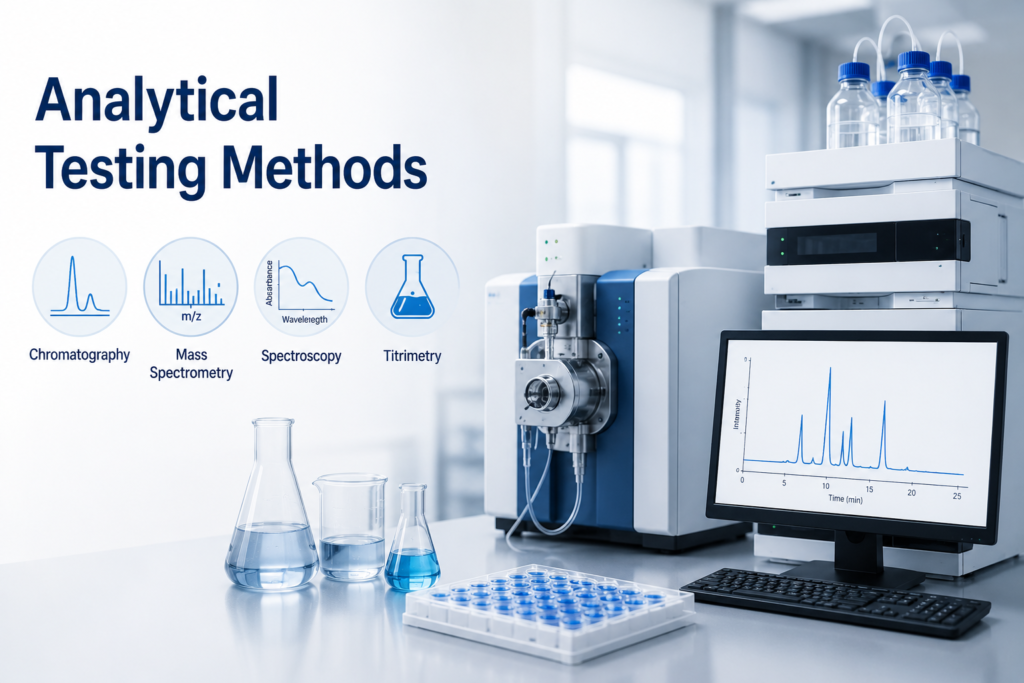
Analytical Testing Methods
Understanding Laboratory Quality Control and Verification
Introduction
Analytical testing plays a critical role in modern laboratory quality-control systems. Through validated scientific methodologies, laboratories can evaluate material characteristics, verify identity, assess purity, and generate objective quality-control data.
Analytical testing supports transparency, batch traceability, documentation standards, and research integrity by providing measurable data obtained through established laboratory procedures.
These testing methods are widely used throughout scientific research, biotechnology, pharmaceutical manufacturing, academic laboratories, and quality-assurance programs.
What Is Analytical Testing?
Analytical testing refers to the use of scientific instruments and laboratory methodologies to evaluate specific characteristics of a material.
Laboratories use analytical testing to generate objective data regarding:
Identity verification
Purity analysis
Quality-control evaluation
Batch consistency
Documentation support
Research validation
Analytical testing provides measurable results that can be reviewed, documented, and associated with specific production lots.
Why Analytical Testing Matters
Quality-control programs rely on analytical testing to support consistency and transparency throughout the research supply chain.
Benefits include:
Improved documentation
Enhanced traceability
Objective measurement
Batch verification
Independent data generation
Quality-assurance support
Analytical testing serves as one component of a broader quality-control framework that may also include documentation review, batch traceability, and additional laboratory evaluations.
Common Analytical Testing Methods
Modern laboratories utilize a variety of analytical methodologies depending on the material being evaluated.
High-Performance Liquid Chromatography (HPLC)
High-Performance Liquid Chromatography (HPLC) is one of the most commonly used analytical techniques in laboratory environments.
HPLC separates individual components within a sample, allowing laboratories to evaluate material composition and generate chromatographic data.
HPLC is frequently used for:
Purity analysis
Quality-control evaluation
Batch consistency review
Analytical documentation
Because HPLC generates highly reproducible data, it remains a cornerstone of modern analytical testing programs.
Liquid Chromatography-Mass Spectrometry (LC-MS)
LC-MS combines chromatographic separation with mass spectrometric analysis.
This methodology allows laboratories to:
Analyze complex samples
Generate molecular data
Support identity verification
Produce highly detailed analytical reports
LC-MS is widely used throughout scientific research and quality-assurance environments.
Mass Spectrometry (MS)
Mass Spectrometry is a powerful analytical technique used to evaluate molecular characteristics.
Mass spectrometers generate data by measuring mass-to-charge ratios associated with molecular components.
Applications commonly include:
Identity verification
Molecular characterization
Analytical research
Laboratory quality-control programs
Mass spectrometry often serves as a complementary analytical method alongside chromatographic testing.
Ultraviolet-Visible (UV-Vis) Spectroscopy
UV-Vis spectroscopy measures light absorption within a sample.
This technique may be used to:
Evaluate sample characteristics
Generate analytical data
Support laboratory research
Verify testing consistency
UV-Vis remains a widely recognized analytical tool across numerous scientific disciplines.
Nuclear Magnetic Resonance (NMR)
Nuclear Magnetic Resonance (NMR) spectroscopy is used to evaluate molecular structures through magnetic field interactions.
NMR is commonly utilized for:
Structural analysis
Identity verification
Research documentation
Analytical investigation
This method provides detailed molecular information that can support laboratory quality-control programs.
Identity Verification
Identity verification is a fundamental component of analytical testing.
The purpose of identity testing is to confirm that a material matches its expected analytical profile.
Methods commonly used include:
LC-MS
Mass Spectrometry
NMR
Chromatographic techniques
Identity verification contributes to transparency and documentation standards within laboratory environments.
Purity Analysis
Purity analysis evaluates the composition of a material and helps identify the presence of additional components within a sample.
Analytical methods commonly used include:
HPLC
LC-MS
Spectroscopic analysis
Purity testing provides objective laboratory data that can be incorporated into quality-control documentation.
Endotoxin Testing and Analytical Programs
Analytical testing programs may also incorporate endotoxin evaluations as part of broader quality-control procedures.
Endotoxin testing can provide additional information regarding:
Process controls
Environmental monitoring
Manufacturing consistency
Laboratory documentation
When applicable, endotoxin testing results may be included within Certificates of Analysis and quality-control records.
Certificates of Analysis and Analytical Data
Analytical testing results are commonly documented within Certificates of Analysis (COAs).
A COA may include:
Product identification
Batch information
Analytical methods
Identity verification data
Purity analysis results
Endotoxin testing information
Testing dates
COAs improve transparency by providing researchers with access to batch-specific laboratory documentation.
Batch Traceability
Analytical testing is most effective when paired with strong batch traceability systems.
Traceability records may include:
Lot numbers
Testing reports
Analytical documentation
Manufacturing records
Quality-control reviews
Maintaining traceability helps ensure analytical results remain associated with specific production lots.
The Role of Transparency in Quality Assurance
Transparency is a cornerstone of modern laboratory quality systems.
Providing access to analytical testing information helps researchers review:
Testing methodologies
Quality-control data
Analytical documentation
Batch-specific records
Supporting laboratory reports
Transparency supports accountability, consistency, and research integrity.
Frequently Asked Questions
What is analytical testing?
Analytical testing refers to scientific methodologies used to evaluate material characteristics and generate objective laboratory data.
What is HPLC?
High-Performance Liquid Chromatography (HPLC) is a laboratory technique commonly used for purity analysis and quality-control evaluation.
What is LC-MS?
Liquid Chromatography-Mass Spectrometry (LC-MS) combines chromatographic separation with mass spectrometric analysis to generate detailed analytical information.
Why is analytical testing important?
Analytical testing supports quality control, documentation, transparency, and batch verification programs.
What information is typically included in analytical reports?
Analytical reports may include testing methods, identity verification results, purity analysis, batch information, and supporting laboratory data.
Why is batch traceability important?
Batch traceability helps maintain accurate records and ensures testing results remain associated with a specific production lot.
Commitment to Quality and Transparency
At T1ER Peptides, transparency, analytical testing, batch traceability, and quality documentation are central components of our quality standards.
Analytical testing provides objective laboratory data that supports research documentation and allows batch-specific information to be reviewed through Certificates of Analysis and supporting quality-control records.
Regulatory Notice
The information provided on this page is intended solely for educational and research documentation purposes.
Products sold by T1ER Peptides are intended strictly for laboratory research use only and are not intended for human or veterinary use.
These products have not been reviewed, approved, or evaluated by the U.S. Food and Drug Administration (FDA). No content on this website should be interpreted as medical advice, treatment guidance, therapeutic information, dosing instructions, or recommendations for human or animal use.